IRONMATE is now available!

Showing posts with label office and/or household materials. Show all posts

Tuesday, August 7, 2018

AirDisc Air Conditioning Technology

PSHS teener invents air-con with air as medium
           Edd K. Usman / BusinessMirror

IMAGINE an air-conditioner that harnesses the air that people breathe every day as cooling medium, and is environment-friendly because it does not use freon, or any chemical refrigerant.

How cool (no pun intended) is that?

Anyway, this is the 21st century and with enough bright minds, every thing is possible. Like harnessing air, which is practically limitless, infinite, inexhaustible!

This time, it is one mind inside the head of a teenager then at the Philippine Science High School in Naga, Camarines Sur, in the Bicol region. Now, she’s in her 19th summer, a “Pisay” (PSHS’s popular name) alumna, and about to enter college at a De La Salle University (DLSU) to take up mechanical engineering. The PSHS is under the Department of Science and Technology (DOST).

Meet Maria Yzabell Angel V. Palma, the young girl behind the AirDisc Air Conditioning Technology, which she developed in 2016 and perfected after one-a -half years while she was still at PSHS-Naga Campus.
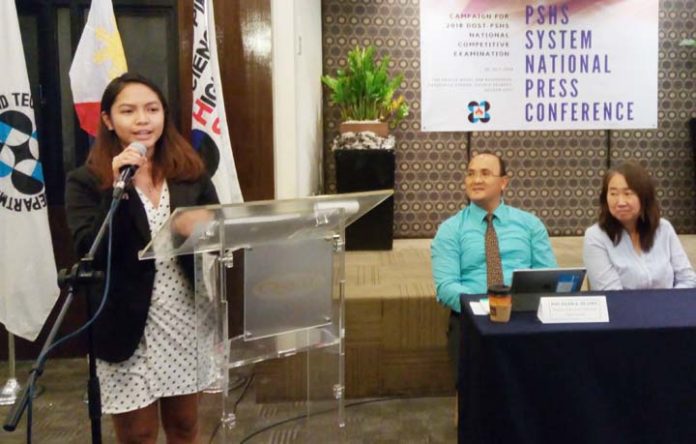
In Photo: Maria Yzabell Angel V. Palma (left), Philippine Science High School (PSHS)-Bicol region campus alumna and inventor of AirDisc Air Conditioning Technology, talks about her brainchild. Listening to her are PSHS System Executive Director Lilia T. Habacon (right) and PSHS System Deputy Executive Director Dr. Rod Allan A. de Lara.
She’s been recognized for her feat by the International Federation of Inventors’ Association (IFIA), which even invited her to Switzerland in February, but she failed to go because she was then graduating.

IFIA got her under its radar after 10 foreign organizations gave her awards for her AirDisc Air Conditioning Technology.

Her most immediate goal is not money, she said; it is helping people and the environment through her brainchild. She estimated that her unit would cost from P25,000 to P40,000. It can be used at home, at offices, or company buildings and other venues.

“I want to help those who cannot afford an air-conditioner,” she said told the BusinessMirror in an interview on July 30 during a news conference with PSHS leaders at a hotel in Quezon City.

That’s where she sees her invention’s significance, recalling that in 2016 more than 100 million units of air conditioners were produced globally but not everybody could afford one, she said.
“This AirDisc will be very affordable to everyone specially the less fortunate. And it is significant to Filipinos. We know it is very hot,there is global warming and it is getting worse every year.

“This cooling system will be a means so the poor, not just the rich, will be able to buy an air-conditioner,” Palma said.

The AirDisc may still be currently quite expensive because it is still new and the production is still limited, but with expected increasing demand and more production its price could go down soon, Palma explained.

She said that loans or installment facilities will be made available to consumers, or it could even be given free of charge, based on the consumer’s economic status.

She added that in the long-run the consumers could save with the use of AirDisc because its electric consumption is low at 150 watts compared to commercial air conditioners which consume 1,200 watts, Palma explained.

No chemical refrigerant

AirDisc Air Conditioning Technology
Palma said the air-conditioning technology that she invented does not use a chemical refrigerant. 

She noted that commercial air-conditioners in homes and cars use hydrofluorocarbon (HFC) chemical refrigerants that are harmful to people and the environment.

She said her design does not use freon and it uses much less electricity. One vital aspect of her invention is its ability to harness air molecules, which, certainly, is abundant, an understatement, to say the least.

“What it will only use as cooling medium is air—the air we breathe,” the young inventor said.

Her invention, she pointed out, uses a new compressor, or more precisely, a centrifugal compressor, which does not build up air moisture inside the compressor and, thus, creates no water residue.

Since AirDisc does not use a chemical refrigerant, she said it will not contribute to greenhouse gases that cause global warming.

The United Nations has mandated the phase out of chemical refrigerants so the use of AirDisc is timely, she explained. It should be noted that 1 kg of HFC is equivalent to 20,000 kg of carbon dioxide which is detrimental to the environment and to people’s health.

Open for partnership

Palma, who got help from her father, a mechanical engineer, said they are finalizing a commercial prototype that is expected to be completed late this year or early-2019, then start manufacturing the AirDisc air-conditioner.

“We are still open for partnership,” the young inventor said, pointing out that at least five companies have already approached her family.

Palma prefers that there will be a manufacturer in every region, like Asia, the United States, and others, “so there will be no monopoly and [that the product will be] well distributed.”
Proverbial light bulb

She recalled how she got the proverbial “light bulb” in her head lighted up and got the idea for a freon-less cooling system.

It was in her project, a cooking equipment similar to an oven she and her classmates were researching in 2016.

She said she noticed “cold air” coming out of the device and then decided to continue a research on it. She consulted her father, of course.

Palma saw in one of her researches in the Internet a study by Japan’s Refrigerant and Air Conditioning Industry that in Africa, one of the hottest places on Earth, has the lowest demand for air-conditioners.

The reason: prices of air-conditioners in African countries are not affordable to the majority of the people, unless one has a stable job.

“Here in the Philippines, my family is not well-off. Every time I turned on the air-condition my mom would tell me to switch it off. As a child, I was asking, ‘why mom does not like to switch the air-condition on,’” said the PSHS alumna. She now realized the reason why: high cost of electricity.

Now, she wants others to benefit from her invention.

“I wish this project will take off because my goal is to help other people, not just for profit or make money. If we can have a big manufacturing company many people will be employed and raise the Philippines’s employment rate,” Palma said. She also wants to have a manufacturing plant in the Philippines.

The patent for her AirDisc Air Conditioning Technology is pending in the United States and in the Philippines.

Awards

The 10 awards Palma received for her AirDisc aircon technology:

Leading Innovator Award from International Intellectual Property Network Forum;
International Leadership Award from Eurobusiness, Haller, Polland;
International Leadership Award from China Association of Invention, China;
Leadership Excellence Award from MyRis, Malaysia;
Leading Student Award from National Research Council of Thailand;
Leading Innovator Award from Indonesian Innovation and Invention Promotion Association, Indonesia;
International Leadership Award from World Invention Intellectual Property Associations (WIIPA), Taiwan;
Best Invention Award from WIIPA, Taiwan;
Special Citation for the Best Invention from MyRIS, Malaysia; and
International Best Young Inventor from Romanian Inventors Forum, Romania.

Low budget

Palma was one of the PSHS alumni and students from some of the science school system’s various campuses across the country who were presented by the PSHS in the media briefing.

The PSHS System management, led by Executive Director Lilia T. Habacon and by her Deputy Executive Director Dr. Rod Allan A. de Lara and other officials, as well as Director Richard P. Burgos of the Science and Technology Information Institute (DOST-STII) campaigned for the school’s 2018 National Competitive Examination.

De Lara said the 16 PSHS campuses are populated by around 8,000 students (all scholars), and has a current year budget of P4 billion.

With that budget, which he conceded is already high but can stand an increase for equipment and laboratory facilities, the “budget per student [of PSHS] is around P200,000 per year.”

The budget is much higher than that of the Department of Education (DepEd) per student at P25,000 every year, he noted. But compared to international standards, like in Singapore, PSHS’s budget is low, he pointed out.

De Lara said the PSHS Campus in Palo, Leyte, Eastern Visayas, got a DNA testing equipment worth $100,000 (around P53 million) only after one of its students, Hillary Diane Andales, won a global science competition that gave her P20 million ($400,000) worth of prizes.

The DNA testing equipment was part of Andales’s prizes. It was donated to her school by the organizers of the Breakthrough Junior Challenge, which is about communicating science as understandable as possible.

De Lara said the PSHS System needs more laboratory facilities and equipment.

He cited the PSHS students’ consistent winning performances in international contests, recalling, for instance, their five-year successive overall championship feats in 2013 in the Asean Plus Three Junior Science Odyssey competition.

Habacon and de Lara said, “we have the brightest students in the Philippines.” They have the numerous awards to back it up.

The awards the PSHS scholars have reaped included those from the Olympiad mathematics competitions, such as two gold (Malaysia, April 2017), gold and silver (Singapore, July 2017) and silver (Brazil, July 2017).

Burgos encouraged the PSHS System to initiate a stronger information campaign about its students’ achievements and other activities to attract more youths into science as well as let Filipinos know about the 16 campuses of the school in the country’s 16 regions.

Source and Photo Credits: 
Business Mirror, Edd K. Usman, Angel Palma

Friday, June 16, 2017

Aerogas Catalytic Combustor (ACC)

Aerogas Catalytic Combustor (ACC): anti-pollution, eco-friendly Filipino invention 
              Engr. Marino C. Martinez (edited)

Aerogas Catalytic Combustor (ACC) is an anti-pollution, fuel saver and power booster engine device. It has practical application on all types of internal combustion engines like engines of Jeeps, Cars, Trucks, Ships and Motorcycles and even Gas Fired Power Plants at a very economical cost. It was invented by Engr. Marino C. Martinez, a chemical engineer. 

The Aerogas Catalytic Combustor (ACC)
The gadget has been rigidly tested with machines and on the road by government agencies like DENR-EMB, DOST – PICIERD, ITDI, LTO and private users at the onset of legislation of the Philippine Clean Air Act of 1999. These are proofs of the effectiveness of the ACC to reduce pollution by as much as 82%, fuel saving by as much as 32%, increase horse power and torque by as much as 7.95%. These figures shows that engine combustion efficiently has significantly improved if not perfected.

The Philippine Clean Air Act of 1999 under Section 3 states, 'the state shall pursue a policy of balancing development and environmental protection. To achieve this end, the framework for sustainable development shall be pursued. It shall be the policy of the state to:

C. “Focus primarily on pollution prevention rather than control...” '

Thus, the strongest issue on the climate change are not the results but the cause which comes from emissions; the carbon dioxide (a green house gas) and primarily the largest contributor to global warming. It is normally assumed that the amount of the CO2 given off is directly related to the amount of fuel burnt. However CO2, CO, HC (hydrocarbons) can be significantly reduced by introducing elements to the combustion reaction that dissociates oxygen from the hydrocarbon compounds, separating and increasing individual elements like carbon particles (as soot), oxygen gas and the largest amount which is water vapor in the engine emissions. Thus, largely reducing CO2, HC and even NOx (oxides of nitrogen) which are poisonous and pollutant greenhouse gases in the atmosphere. 
DENR-EMB Test Results on May 1999 showing 82%
reduction of HSU reading with installed ACC
ACC utilizes this process: the Chemistry of Sublimation – releasing purified gas elements to create high speed flame when ignited simultaneously with hydrocarbon fuels in the internal combustion chamber separating carbon from oxygen to deplete CO2 and poisonous gases. Because of its high speed flame, the elements reaction is compatible to all levels of octane rating for gasoline fuel and cetane for diesel fuel, thus detonation does not occur (detonation creates detrimental effects to the engine.) the high speed flame significantly increases if not inducing complete combustion. In the process, CO2 and other harmful gases are depleted significantly reducing health problems and global greenhouse gas emissions, ultimately mitigating the devastating results of climate change.

Despite ACC's current effectiveness, we continuously do research and development to improve ACC to a much more better product in the future which is more effective in minimizing the hostile effect of global warming and combating the increasing hydrocarbon fuel price.

Paris Agreement is our world's second attempt from the first, the Paris Protocol, to mitigate the effect of climate change. This is our chance to do it the Filipino way!

Source and Photo Credits: 
Engr. M. C. Martinez via e-mail

Monday, December 14, 2015

SALt Lamp

Pinay scientist creates lamp that runs on saltwater
                  Rhys Buccat, ABS-CBNnews.com
                  Posted at 08/02/15 4:43 PM

MANILA – “To light up the rest of the Philippines sustainably” was the vision of Filipina scientist Aisa Mijeno when she made the Sustainable Alternative Lighting (SALt) lamp. The SALt Lamp is an environment-friendly and sustainable alternative light source that runs on saltwater, making it suitable to those who live in coastal areas. It can also function well in remote barrios. With just two table spoons of salt and one glass of tap water, this ecologically designed lamp can run for eight hours.

“It is made of tediously experimented and improved chemical compounds, catalysts, and metal alloys that when submerged in electrolytes will generate electricity,” Mijeno explained in an interview with ABS-CBN.

Aisa holding her SALt Lamp

Because of its inspiring vision and ground-breaking innovation, the SALt lamp has received various awards and recognition from organizations in the Philippines, Singapore, Japan, and South Korea. It has also won in several competitions here and abroad.

Safe alternative to traditional lamps

According to Mijeno, the idea behind the SALt lamp is the chemical conversion of energy. It utilizes the scientific process behind the Galvanic cell, but instead of electrolytes, the SALt lamp uses saline solution, making it harmless and non-toxic.

Compared with kerosene lamp, the SALt lamp is also a lot safer, Mijeno stressed since it does not have components and compounds that may spark fire. Moreover, it does not emit toxic gases and leaves minimal carbon footprint. “This isn’t just a product. It’s a social movement,” she said.

Although the SALt lamp is not yet being mass-produced, Mijeno and her team have been working intensively with non-government organizations (NGOs), local government units (LGUs), and charitable foundations, among others.

These organizations aid in the purchase and distribution of the SALt lamps to remote communities where electricity is scarce, or worse, not available.

A sustainable light for the Philippines

Mijeno said that her experience working with an environmental organization made her realize the need for an alternative source of light, especially in rural areas of the Philippines.

“I used to be part of Greenpeace Philippines and did personal immersions/volunteers across rural communities, and there I learned so many things. Most of these people are so poor and underprivileged that they endure long hours of walking just to get kerosene for their lamps,” Mijeno recalled.

Currently, for every SALt lamp that is bought, one lamp is given to a selected family.

“Our main focus is on the island communities that do not have access to electricity and have no financial capacity for acquiring alternative source of electricity,” Mijeno added.

Source:

Photo credits:

Friday, August 8, 2014

Body-heat powered flashlight

We had featured in our previous blog about a water-powered invention that can generate electricity. Now, we will tackle another record-breaking and world-changing invention - a flashlight than can be powered solely by body’s heat. Imagine that it will produce light by just holding it. No batteries. Not solar-powered. It’s such an incredible invention!

The inventor of this amazing flashlight is a Filipino-Canadian 15-year old student, Ann Makosinsk. Her project was inspired by a friend from Mindanao whose family could not afford to pay for electricity. Without light at night, her friend could not study properly. She failed an entire school year because she could not read her lessons.

After a few prototypes, she unveiled her “hollow flashlight,” so named because it has a hollow aluminum tube at its core that cools the sides of the peltier tiles attached to the flashlight’s cylinder. The other side is warmed by heat from a hand gripping the flashlight. 

Ann Makosinsk holding her invention, the "Hollow Flashlight" 
Ann spent several months designing the flashlight and figuring out its voltage conversion. Much has been written online about powering a flashlight with peltier tiles, but those devices used heat from candles and blow torches. Ann’s patent-pending prototype relies on hand warmth only and required that she make her own transformer, among other difference-making factors. She said that her invention needs at least 3 to 5 degrees Celsius temperature difference to work. She added that the flashlight is ideal for cold temperature because the larger the temperature differential, the greater the light produced. 

Though her invention is not yet ready for commercialization and need to be improved, it was good enough for her to win the 2013 Google Science Fair in the 15-16 years old category beating out thousands of other students from over 120 countries and earned praises by many. Her story has been shared several times in social media and has caught the interest of several people, including American TV host Jimmy Fallon.

Makosinski says her flashlight can produce up to 5-foot “candles of brightness”—below the commercial standard—but she says she is working to make the light brighter. It produced roughly 24 lumens compared to dozens or even hundreds of lumens of light produced by commercial flashlights. She says several companies have voiced interest in her flashlight. But she is adamant that until her flashlight achieves higher brightness at a lower cost, she will not agree to produce it for the public.

Driven by a very noble objective, she said, “I want to make sure my flashlight is available to those who really need it.”

Source:

Sunday, March 2, 2014

Air Cleaning Device with Ionizer (Nature's Air Room Ionizer)

A breath of fresh air

Nature's Air air cleaning device with ionizer

Air pollution may well be dubbed as the silent killer for it harms the unsuspecting individual who inhales its harmful micro-components. Through the years, the quality of air in many parts of the world has been deteriorated continuously and beyond acceptable standards. There are several types of air pollutants but the most common are particulate matters, nitrogen dioxide, carbon monoxide, and total oxidants. Other equally harmful air pollutants are hydrocarbons and nitrogen oxides. Medical experts discovered 18 species of pathogenic fungi and 20 types of bacteria in the circulating dust.

Metro Manila's surrounding air has no cleaner. A study done by the Department of Environmental and Natural Resources (DENR) and the Asian Development Bank (ADB) found that pollution level in the metropolis is three times the normal level with particulate matter of nearly 600 exceeding the WHO safe dust level of 120 micrograms per cubic meter of air.

Now, we are introducing our latest technology, an air cleaning device with ionizer that will eventually removes smoke, dust particle, odors and even air-borne micro-organisms that spread diseases inside your room and your office. 

Benefits of Nature's Air
  • It will remove airborne contaminants.
  • Activated carbon filter will remove odors/fumes emitted from closets, household cleaners, paints varnishes, personal care products, cigarettes and cooking smoke.
  • Negative ions revitalized the air just like the natures after the storm, near a waterfall or near the seashore. Studies show that the negative ions beneficially affect human biochemistry both physically and mentally.
Description

Nature's Air, an environmental friendly invention, is a perfect solution for this kind of environment that we suffer from odors and microorganisms. This latest Filipino technology helps eliminate harmful dust particles, smoke and airborne microorganism that spread diseases in children and elderly.

The properly-designed modern ion emitter produces a combination of negative and positive ions in a ratio of 4:3. This ratio helps the dust particles and carbon monoxide settle to the dust collector inside the unit, rather than on other surfaces. The excess of negative ions also helps to restore nature’s ion balance and enhance natural health and well being of the user.

Technical specifications


A new and improved air ionizer, the NATURES AIRE is available for purchase. Go to our online store for contact details.

Source:
Rodolfo Biescas Sr.

Sunday, July 14, 2013

Filipino inventions: 2BIG POWER and Tubig-powered Machine - green solution to scarce electricity

Aiming to help his Filipino countrymen, Stevenson “Steve” Rejuso invented the LED Lamp Portable DC Generator or simply known as 2BIG POWER. The invention generates electricity and enables to light its LED bulb using water as a fuel.

Screen shot of ABS-CBN's video in YouTube
featuring 2BIG POWER being filled with water
According to him, 2BIG POWER lights up to 3-4 days depending on the amount of water added and capable of producing 3-10 watts. The device doesn’t need clean water for it to light. It works also with dirty water, seawater, freshwater, buko juice, or even wastewater.

Along with 2BIG POWER, he also invented the Tubig-powered Machine prompted with the shortage of electricity in their area. The device can light a flashlight, a lamp post, charge batteries and battery pack of cellular phones or even power a transistor radio and can light a village for two weeks. Same with his 2BIG POWER, it generates electricity using water.

The principle for both of his devices is simple. The production of electricity happens through a reaction between the several metal plates inside the device chamber aided by the addition of water. Water serves as an electrolyte that enables the ions from different plates to pass through. Since it consists of many plates, it produces electricity strong enough to have an economical value.

Sir Rejuso is a member of the Filipino Inventors Society (FIS) and known for his inventions here and abroad. He was featured in ABS-CBN separate programs, IMBENSIYON and Kabuhayang Swak na Swak. He said that many foreign countries are interested for the sale of his inventions. However, he refused the offer because he wants that Filipinos to benefit first.

2BIG POWER is safe to use compared to the candles and oil lamps as source of light. It is more economical and environment-friendly. On the other hand, Tubig-powered Machine is now functioning at Brgy. Greater Lagro, Quezon City, Metro Manila.

His inventions are very useful especially in areas where electricity is scarce. He is aiming to reach far-flung places of the Philippines where service of electricity is not available.

Source:

Photo and video credits:
YouTube

Friday, July 12, 2013

IRONMATE® - cut your flat iron electrical consumption up to 53%, a diligent Filipino invention

Electric bills, water bills, phone bills, internet bills, credit card bills and all other bills are the main recipients of Filipinos' income at the end of the month. What’s left for an average income earners whose salaries are barely enough for the family’s food and everyday needs?

Cutting down these bills are necessary. If not to eliminate, at least reduction shall be done. In the case of electric bill, some people resort to cut their electrical consumption illegally especially those who are leaving in overpopulated areas. But what if we can do it legally without compromising a necessary household chore that needs electricity? Yes, there’s a way. 

An IRONMATE® promotional banner
Electric iron is one of the appliances that consumes electricity a lot. A typical clothes iron has 1000-1800 wattage. To save electricity, a former teacher in Albay, Rodolfo B. Biescas, Sr. invented the IRONMATE®. Due to his love for the ordinary Pinoys, and believing that the Filipino is a creative persona and has strong global-standard that one can be the pride of Asia, he began inventing and innovating things that Filipinos may benefit. He believes that “Necessity is not the mother of all Inventions” because there are inventions that are not necessity like those that causes destruction. IRONMATE® was invented in 1988. Sir Biescas applied patent in 1990 and granted in 1991. 

The IRONMATE® is a device which automatically shuts off the electrical flow towards the flat iron when the iron is rested or not in use without losing the heat energy. It can save up to 50-53% of energy consumption and electricity cost. It is portable and made of fiber plastic crystals, with the stainless steel plate and a heat indicator at the rear side.

Major highlights of the IRONMATE® include: 
  • Timely energy saving & fire safety device for flat iron. 
  • Pay only what you actually consume in ironing clothes 
  • Multi-awarded Filipino invention 
  • Conserves heat and reduce electrical consumption by 50-53%. 
  • Controls built-in loss in ironing – electrical consumption automatically stops and heat conserved when the flat-iron presses the push button while rested on the IRONMATE® during frequent idle periods
  • Ensures fire safety in ironing 
  • Automatic shut off power 
  • Portable and easy to use. 
  • Affordable 
Specifications: 
  • Voltage: 220v 
  • Power Capacity: 1000 watts 
  • Fuse: 10mA
Due to the excellence of the product, it became a recipient of the following awards.
  • 1993 National Inventors week and Golden International Expo ’93 – Gold Medal 
  • 1999 Phil. Official Entry to: 27E Salon International DES Inventors- Geneva, Switzerland 
  • 1999 Official Delegates to Europartenariat, Vienna Austria I-TEX 2000 international Invention, Invention Industrial Design and Technology 
  • Putra World Trade Center – Malaysia – Broze Medal 
  • National Inventors week 2000- Tuklas Award – Outstanding Invention
The IRONMATE® was featured in various television programs such as SiS of GMA7, Shopping Network (ShopTV),  and Venta5 in ABC 5. 

Rodolfo B. Biescas Sr.,
inventor of the IRONMATE®
Among his other high-impact technology inventions and innovations which concretely addresses pressing global concerns on energy, environment and health are the following: Multi-Cooler Fan (Semi Air Conditioning Unit), Ironmate Economizer (Energy Saving Device for Flat Iron), Super Flame (Charwood Stove) Brickcoal (Charcoal Briquettes) Cosmic Pure (Water Purifier), The Pacman (Mechanical Street Sweeper), Sapun (Sanitary Disposal Toilet Seat Cover), and Nature’s Air (Car and Room Ionizer), a timely health advocacy during this times of spreading environmental pollution in society. He is also one of the founders of the Filipino Multi-Purpose Cooperative and credited for eight inventions/innovations which he developed, patented spanning 25-year period (since 1982).


To order this product, contact 09293189480 or 09759270863. You may also send an e-mail inquiry to BuyPinoyInvention@gmail.com.

Tangkilikin po natin ang sariling atin.

Source: 
energy.gov
opinyon.com
Rodolfo B. Biescas Sr.
YouTube

Photo credit:
Rodolfo B. Biescas Sr.

Monday, July 8, 2013

HAPEE - the first Filipino toothpaste brand

Lamoiyan/Hapee, 25 years of business & CSR success
                                         BULL MARKET BULL SHEET by Wilson Lee Flores (The Philippine Star)
                                         Updated May 6, 2013 - 12:00am

A distinctive homegrown consumer brand in Philippine business, Hapee toothpaste and its founder Cecilio Kwok Pedro is this year celebrating the brand’s 25th anniversary, not just of flourishing business, but also of diverse civic undertakings through their strong corporate social responsibility (CSR). Apart from strengthening its market share locally, Hapee plans to continue expanding overseas.
Dr. Cecilio Kwok Pedro
President and CEO, Lamoiyan Corp
.
A Christian entrepreneur who passionately believes in private business with a social conscience, Cecilio K. Pedro has supported the international non-governmental organization (NGO) Operation Smile Philippines to care for children afflicted with oral cleft. His factory is unique and noted for employing a lot of hearing-impaired people.

Lamoiyan Corp. has also donated dental equipment and supplies to the newly inaugurated Manila Cleft Care Center in Sta. Ana Hospital, Manila City. 

Cecilio K. Pedro has also donated various public school-buildings to poor rural regions of the Philippines through the “Operation: Barrio Schools” project of the Federation of Filipino Chinese Chambers of Commerce & Industry, Inc. (FFCCCII), of which he was in March elected one of this civic and business group’s new vice presidents.

Humble beginnings of a well-loved Philippine brand

Like Jollibee in fast food and Bench in fashion, Hapee has become a progressive homegrown Filipino brand competing directly with top multinational brands. How did this brand and product start 25 years ago by seizing an unexpected business opportunity?

The prime mover behind Hapee toothpaste is entrepreneur Dr. Pedro, president and chief executive officer of Lamoiyan Corporation. He started out in the 1970s as an aluminum toothpaste tubes manufacturer to the multinational firms.

In 1985, the multinationals started changing their toothpaste packaging from aluminum to plastic tubes, so Pedro was stuck with industrial equipment but no customers, plus a stockpile of aluminum tubes. Faced with this crisis, he decided to venture into toothpaste manufacturing with affordable Hapee and Kutitap brands. Lamoiyan, the firm name, came from the name of Pedro’s beloved grandmother, a gesture of filial love.

Like a David challenging the well-established Goliaths who have for generations cornered the local market, Pedro changed the dental care landscape in the country by introducing his own locally-made, world-class quality and affordable toothpaste brand as a new alternative.

How did Dr. Cecilio K. Pedro come up with the brand name Hapee? He said: “Initially, the brand I chose was Smile because when you brush your teeth, you are supposed to smile. When you frown, it becomes difficult to brush your teeth. And when you smile, you look happy.”

However, Pedro discovered that the brand “Smile” had already been registered and owned by a multinational company. He nevertheless came up with another brand name with the same positive mindset and cheerful disposition, which best describes the feeling of people who smile.

A Hapee toothpaste variant
“I thought ‘happy’ did not seem suitable as a brand, so I changed it from ‘h-a-p-p-y’ to ‘h-a-p-e-e,’” Pedro explained. The choice of “Hapee” as brand name was deemed by marketing observers as “a stroke of genius” due to its easy and positive brand recall in the Philippines and eventually in several foreign markets as well.

Social mission: Offering affordable Filipino brand for basic dental care

The 25-year journey of Lamoiyan Corporation and Hapee toothpaste has been historic and fulfilling. Dr. Pedro, his dedicated team of executives and employees competed versus the multinationals with innovations, marketing initiatives and consistent world-class quality. They envision Hapee to be at par with multinational brands.

Why such optimism about the prospects for Hapee toothpaste? Pedro believes that Filipino consumers are ready for a good-quality Filipino-made toothpaste as an alternative and affordable brand.

National University (NU) College of Dentistry dean Dr. Joseph Dy Lim of Dr. Smile Dental Center at Podium Mall told this writer that one of the social problems of Philippine society is the large proportion of urban and rural poor who do not have adequate dental hygiene practices and basic dental care services.

The Professional Regulation Commission (PRC) Board of Dentistry chairman Dr. Steve Mark G. Gan of Gan Advanced Osseointegration Center (GAOC) also said that much can still be done to improve accessibility of basic dental care nationwide.

Pedro said: “We introduced world-class quality toothpaste at affordable prices so that many Filipinos can afford to brush their teeth regularly. We found out that many Filipinos, especially in the provinces, could not brush their teeth because toothpaste and toothbrush are expensive. That dream pushed us initially and we were not afraid to face the multinational companies because we believe there is this need to help Filipinos, especially those belonging to the poorest of the poor.”

For entrepreneur Pedro, his business has a mission to help improve the people’s quality of life through affordable and good dental products, and his employees share his sense of mission for the past 25 years. 

“Every year we survive the competition thrown at us and we celebrate each happy moment. Every day that I wake up I consider it a happy moment, thanking God for giving me another day. There are so many challenges and difficulties in this world but it really depends on how you look at life. For me, we are so blessed as a country and as a people. We are fortunate here in Lamoiyan Corporation and we tell the world that yes, we can survive and we can compete with the best of the best in the world,” he said.

Corporate social responsibility as part of Lamoiyan & Hapee DNA

Under the idealistic Dr. Pedro, corporate social responsibility (CSR) in Lamoiyan Corporation is considered an intrinsic aspect of the company’s DNA or reason for existence. He said: “Here at Lamoiyan Corporation, we are fueled by our corporate philosophy which is to make a difference for the glory of God.”

Lamoiyan's hearing-impaired employees
One of the admirable company policies of Lamoiyan is its hiring the hearing-impaired, who make up about 30 percent of their total workforce and who receive equal opportunities. Proper attention and training are given them. He said: “I call them angels sent by the Lord. When I see them, I’m happy because they were provided by the Lord.” Pedro further elaborated on Lamoiyan’s experiences with the hearing-impaired: “We have very good experiences with the hearing-impaired as they are always among the top performers. It is quite good to note that every year, around six or seven of them are in the Top 10 best performers. It is indeed very rewarding and fulfilling to provide jobs to people who may not be as fortunate as us. At the same time, we are able to promote better relationships and a culture of compassion and harmony inside the company. This, I think, is what makes us different from the world and this is what we believe is making a difference for the glory of God.”

Going global, growing beyond the Philippines

This writer was part of the Philippine business delegation that visited Myanmar in March, and I observed that one of the entrepreneurs most assiduous in looking out for economic opportunities in that country was Hapee’s Dr. Pedro.

The past quarter century of Hapee success in the Philippines has witnessed the growth of Lamoiyan Corporation’s manufacturing facilities in ParaƱaque, Hapee toothpaste’s new flavors and the addition of new product lines in the household and personal care segments through brands like Gumtect, Kutitap, Dazz and Licealiz.

Pedro said that this year Hapee toothpaste is setting its sights higher to go global with its commitment to world-class quality at affordable prices.

He said: “We are very bullish about 2013; we believe this is the year when we will grow faster than before. This is the year where we will probably also explore exports to other countries, particularly Southeast Asia, by the grace of God. We will again be facing the multinational companies, so hopefully we will gain some footing (there) in the very near future.”

To know more about how Lamoiyan Corporation gives hope to Filipinos and shares smiles, visit www.lamoiyan.com or www.facebook.com/LamoiyanCorporation.

Source:
Philstar

Photo credit: 

Lamoiyan Corp.
Philstar

Sunday, July 7, 2013

Quink fountain pen ink - a Filipino invention

Writing is a form of transmitting information through textual media using a set of signs and symbols which is known as the writing system. Throughout history, writing has been a mode of communication which probably resulted from the consequence of political expansion. According to H.G. Wells, writing has the ability to "put agreements, laws, commandments on record. It made the growth of states larger than the old city states possible. It made a continuous historical consciousness possible. The command of the priest or king and his seal could go far beyond his sight and voice and could survive his death".

Today, we are more adept to communicate one another through the use of internet, cellphones, telephone, etc. We convey our “written” messages through social media and/or emails. If we need a concrete copy, we may be able to print the message with ease. However, we still employ the original concept of writing using pen and paper. Today, we utilize different types and designs of pen depending on the material or project we work for. But one of a pen’s characteristics is having an ink, whatever type it may be.

Before ballpoint pens (pens we commonly use today) came into being, the famous fountain pen was marketed. Maybe your parents and grandparents know about how beautiful these pens are. Its difference to ballpoint pen is that its a nib pen that contains an internal reservoir of water-based liquid ink. It draws ink from the reservoir through a feed to the nib and deposits it on paper via a combination of gravity and capillary action. Filling the reservoir with ink may be achieved manually or via an internal filling mechanism which creates suction to transfer ink directly through the nib into the reservoir. Some pens employ removable reservoirs in the form of pre-filled ink cartridges. A fountain pen needs little or no pressure to write. 
The PARKER 51 fountain pen with the marketing slogan:
"Writes dry with wet ink!"

Today, fountain pens are often treated as luxury goods and sometimes as status symbols because they are expensive. Fountain pens may serve as an everyday writing instrument also much like the common ballpoint pen. Good quality steel and gold pens are available inexpensively today, particularly in Europe and China, where there are "disposable" fountain pens. such as the Pilot Varsity. In France, in particular, the use of fountain pens is well spread.

Fountain pens ink

Because fountain pens operate on the principle of capillary action, ink for them is almost exclusively dye-based. Pigment-based inks (which contain solid pigment particles in a liquid suspension) tend to clog the narrow passages of the pens. Some pigmented inks do exist for fountain pens, but these are uncommon. India ink, a carbon pigment-based ink, also contains a binder (such as shellac), which can quickly clog such pens. The ideal fountain pen ink is free-flowing, free of sediment, and non-corrosive. These qualities may be compromised in the interests of permanence, manufacturability, and in order to use some widely available dyes.

A form of ink that pre–dates fountain pens by centuries is Iron gall ink. This blue–black ink is made from iron salts and tannic acids from vegetable sources. It was used in fountain pens when they were invented, but has the disadvantage of causing corrosion to metal parts. Modern formulations of Iron gall ink are somewhat less corrosive and are still occasionally used in applications that require permanence.

Red inks usually contain the dye, Eosin. Blue inks often contain Triarylmethane dye. In addition to water, the non-dye components (collectively referred to as the vehicle) might include, polymeric resins, humectants to retard premature drying, pH modifiers, anti-foaming agents and biocides, to prevent fungal and bacterial growth, and wetting agents (surfactants). Surfactants reduce the surface tension of the ink – distilled water has a surface tension of 72 dyn/cm (72 × 10−3 N/m) but the desirable value for ink is between 38 and 45 dyn/cm (38 to 45 × 10−3 N/m). If the ink's surface tension was too high, then it would not flow through the pen; if it was too low, then the ink would run out of the pen with less control.

Filipino: part of fountain pen’s ink development

But do you know that a Filipino was a part of the fountain pens development? Francisco Quisumbing is a Filipino chemist known for being the inventor of Quink ink used by The Parker Pen Company. He graduated from the University of Chicago under the American pensionado program. He went back to the Philippines after World War II but was unable to organize the Philippine Ink Corporation under the Japanese Reparations Program because of too much government intervention. Quink stands for Quisumbing Ink. However, Parker states that the name is an amalgam of "quick and ink".

The Quink

Quink was first marketed in 1931. The resulting product was strongly alkaline and contained isopropyl alcohol, a solvent not previously used in inks. At that time, most pen barrels and caps were manufactured using pyralin, which was often damaged by the alcohol contained in Quink. This problem eventually led to the development of the successful fountain pen, the Parker 51. A common misconception about Quink is that it was intended to be the ideal ink for the Parker 51, which generated over 400 million dollars in sales during its thirty-year history. The Parker 51 pen was the only pen of the time capable of using Quink effectively. However, the Parker 51 was only made available in 1941, ten years after Quink's development. Quink features the following useful characteristics that made it a successful ink for fountain pens:
  • it resisted water
  • it did not clog
  • it had the desired quality of ink flow
  • it resisted moulding
  • it was non-corrosive
  • it did not leave deposits
  • it did not fade
  • it was quick-drying
Parker's Quink ink bottle
Quink was manufactured in four colors: India Black, Pan American Green, China Red and the famous Tunis Blue. It was sold in bottles made by the Armstrong Cork Company, Lancaster, PA. The bottles were designed with a low centre of gravity to prevent tipping. The ink was to have several improvements over the years; an even quicker-drying product appeared in 1939 called "Double Quink." It included a further refinement in the addition of the chemical SOLV-X which dissolved sediment and cleaned the pen when writing.

In 1941, when the Parker 51 was launched, Double Quink was renamed and repackaged as "Parker 51 ink" for marketing purposes. Parker's ink sales became the key to maintaining the company's profitability. Further enhancements were made to Parker inks and the company subsequently introduced "Superchrome" ink, proclaimed as revolutionary by the manufacturer. "Superchrome" ink was marketed in 1947 after a seventeen-year research period that cost over USD$200,000. Parker marketed the product as the "first basic ink improvement in over 250 years" that offered near-instant drying, greater "brilliance" (or brightness) and availability in a wider selection of colors. Regular Quink is not waterproof, unlike India ink. If paper that has been written on becomes wet, black ink will run and separate into blue and yellow components.

The Quink today

Quink remains a popular ink product and was described as a "great all around ink" in an online fountain pen ink review. According to fountain pen enthusiasts, Parker Quink is generally considered to be "safe fountain pen ink"; this means that it should not stain or clog fountain pens very easily.

The use of fountain pens gradually decreased during the second half of the twentieth century. Consequently, Parker 51 ink was phased out in the United Kingdom (UK) in 1972 and the US in 1978. However, a large worldwide network of collectors and enthusiasts continue to use the Parker 51 pen in the twenty-first century, with a limited edition of the model (available in two colors, "Vista Blue" and black) released by Parker in 2002. As part of the 2002 product revival, Parker promoted its quick-drying ink as the ideal accompaniment for the Parker 51.

Source: http://en.wikipedia.org/wiki/Quink
            http://en.wikipedia.org/wiki/Writing
            http://en.wikipedia.org/wiki/Parker_51
            http://en.wikipedia.org/wiki/Fountain_pen
            http://en.wikipedia.org/wiki/Fountain_pen_ink
            http://en.wikipedia.org/wiki/Francisco_Quisumbing
Photo credit: http://www.fountainpennetwork.com
                    http://en.wikipedia.org/wiki/File:Parker_Quink_Bottle.jpg

Monday, June 24, 2013

GOODFIRE kerosene-fueled stove


For Filipinos, cooking in a stove fueled with kerosene is an alternative to LPG-fueled one. We can see these types of stoves in various places throughout the country --- in homes, in streets (vendors selling banana-Q, camote-Q, kikyam, fishball, etc.) and in places where ordinary Filipino citizens can't afford to buy expensive tanks of LPG but do not opt to use firewoods in cooking.

Do you know who invented the most common GOODFIRE Kerosene-fueled Stove? For more than 50 years, Inventor Enrique L. Laguinia has been supplying the country with his low-cost, low-maintenance and low-risk GOODFIRE cooking stoves.

A salute to you Sir! We're proud of you in helping the lives of Filipino people with your famous and "PANG-MASA' invention.