IRONMATE is now available!

Showing posts with label construction and/or manufacturing. Show all posts

Tuesday, August 7, 2018

AirDisc Air Conditioning Technology

PSHS teener invents air-con with air as medium
           Edd K. Usman / BusinessMirror

IMAGINE an air-conditioner that harnesses the air that people breathe every day as cooling medium, and is environment-friendly because it does not use freon, or any chemical refrigerant.

How cool (no pun intended) is that?

Anyway, this is the 21st century and with enough bright minds, every thing is possible. Like harnessing air, which is practically limitless, infinite, inexhaustible!

This time, it is one mind inside the head of a teenager then at the Philippine Science High School in Naga, Camarines Sur, in the Bicol region. Now, she’s in her 19th summer, a “Pisay” (PSHS’s popular name) alumna, and about to enter college at a De La Salle University (DLSU) to take up mechanical engineering. The PSHS is under the Department of Science and Technology (DOST).

Meet Maria Yzabell Angel V. Palma, the young girl behind the AirDisc Air Conditioning Technology, which she developed in 2016 and perfected after one-a -half years while she was still at PSHS-Naga Campus.
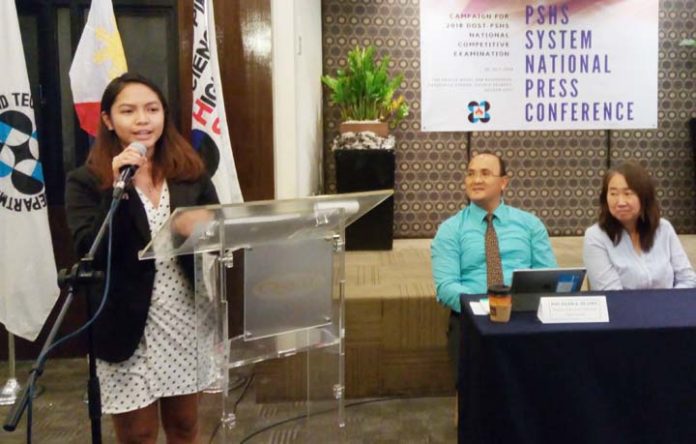
In Photo: Maria Yzabell Angel V. Palma (left), Philippine Science High School (PSHS)-Bicol region campus alumna and inventor of AirDisc Air Conditioning Technology, talks about her brainchild. Listening to her are PSHS System Executive Director Lilia T. Habacon (right) and PSHS System Deputy Executive Director Dr. Rod Allan A. de Lara.
She’s been recognized for her feat by the International Federation of Inventors’ Association (IFIA), which even invited her to Switzerland in February, but she failed to go because she was then graduating.

IFIA got her under its radar after 10 foreign organizations gave her awards for her AirDisc Air Conditioning Technology.

Her most immediate goal is not money, she said; it is helping people and the environment through her brainchild. She estimated that her unit would cost from P25,000 to P40,000. It can be used at home, at offices, or company buildings and other venues.

“I want to help those who cannot afford an air-conditioner,” she said told the BusinessMirror in an interview on July 30 during a news conference with PSHS leaders at a hotel in Quezon City.

That’s where she sees her invention’s significance, recalling that in 2016 more than 100 million units of air conditioners were produced globally but not everybody could afford one, she said.
“This AirDisc will be very affordable to everyone specially the less fortunate. And it is significant to Filipinos. We know it is very hot,there is global warming and it is getting worse every year.

“This cooling system will be a means so the poor, not just the rich, will be able to buy an air-conditioner,” Palma said.

The AirDisc may still be currently quite expensive because it is still new and the production is still limited, but with expected increasing demand and more production its price could go down soon, Palma explained.

She said that loans or installment facilities will be made available to consumers, or it could even be given free of charge, based on the consumer’s economic status.

She added that in the long-run the consumers could save with the use of AirDisc because its electric consumption is low at 150 watts compared to commercial air conditioners which consume 1,200 watts, Palma explained.

No chemical refrigerant

AirDisc Air Conditioning Technology
Palma said the air-conditioning technology that she invented does not use a chemical refrigerant. 

She noted that commercial air-conditioners in homes and cars use hydrofluorocarbon (HFC) chemical refrigerants that are harmful to people and the environment.

She said her design does not use freon and it uses much less electricity. One vital aspect of her invention is its ability to harness air molecules, which, certainly, is abundant, an understatement, to say the least.

“What it will only use as cooling medium is air—the air we breathe,” the young inventor said.

Her invention, she pointed out, uses a new compressor, or more precisely, a centrifugal compressor, which does not build up air moisture inside the compressor and, thus, creates no water residue.

Since AirDisc does not use a chemical refrigerant, she said it will not contribute to greenhouse gases that cause global warming.

The United Nations has mandated the phase out of chemical refrigerants so the use of AirDisc is timely, she explained. It should be noted that 1 kg of HFC is equivalent to 20,000 kg of carbon dioxide which is detrimental to the environment and to people’s health.

Open for partnership

Palma, who got help from her father, a mechanical engineer, said they are finalizing a commercial prototype that is expected to be completed late this year or early-2019, then start manufacturing the AirDisc air-conditioner.

“We are still open for partnership,” the young inventor said, pointing out that at least five companies have already approached her family.

Palma prefers that there will be a manufacturer in every region, like Asia, the United States, and others, “so there will be no monopoly and [that the product will be] well distributed.”
Proverbial light bulb

She recalled how she got the proverbial “light bulb” in her head lighted up and got the idea for a freon-less cooling system.

It was in her project, a cooking equipment similar to an oven she and her classmates were researching in 2016.

She said she noticed “cold air” coming out of the device and then decided to continue a research on it. She consulted her father, of course.

Palma saw in one of her researches in the Internet a study by Japan’s Refrigerant and Air Conditioning Industry that in Africa, one of the hottest places on Earth, has the lowest demand for air-conditioners.

The reason: prices of air-conditioners in African countries are not affordable to the majority of the people, unless one has a stable job.

“Here in the Philippines, my family is not well-off. Every time I turned on the air-condition my mom would tell me to switch it off. As a child, I was asking, ‘why mom does not like to switch the air-condition on,’” said the PSHS alumna. She now realized the reason why: high cost of electricity.

Now, she wants others to benefit from her invention.

“I wish this project will take off because my goal is to help other people, not just for profit or make money. If we can have a big manufacturing company many people will be employed and raise the Philippines’s employment rate,” Palma said. She also wants to have a manufacturing plant in the Philippines.

The patent for her AirDisc Air Conditioning Technology is pending in the United States and in the Philippines.

Awards

The 10 awards Palma received for her AirDisc aircon technology:

Leading Innovator Award from International Intellectual Property Network Forum;
International Leadership Award from Eurobusiness, Haller, Polland;
International Leadership Award from China Association of Invention, China;
Leadership Excellence Award from MyRis, Malaysia;
Leading Student Award from National Research Council of Thailand;
Leading Innovator Award from Indonesian Innovation and Invention Promotion Association, Indonesia;
International Leadership Award from World Invention Intellectual Property Associations (WIIPA), Taiwan;
Best Invention Award from WIIPA, Taiwan;
Special Citation for the Best Invention from MyRIS, Malaysia; and
International Best Young Inventor from Romanian Inventors Forum, Romania.

Low budget

Palma was one of the PSHS alumni and students from some of the science school system’s various campuses across the country who were presented by the PSHS in the media briefing.

The PSHS System management, led by Executive Director Lilia T. Habacon and by her Deputy Executive Director Dr. Rod Allan A. de Lara and other officials, as well as Director Richard P. Burgos of the Science and Technology Information Institute (DOST-STII) campaigned for the school’s 2018 National Competitive Examination.

De Lara said the 16 PSHS campuses are populated by around 8,000 students (all scholars), and has a current year budget of P4 billion.

With that budget, which he conceded is already high but can stand an increase for equipment and laboratory facilities, the “budget per student [of PSHS] is around P200,000 per year.”

The budget is much higher than that of the Department of Education (DepEd) per student at P25,000 every year, he noted. But compared to international standards, like in Singapore, PSHS’s budget is low, he pointed out.

De Lara said the PSHS Campus in Palo, Leyte, Eastern Visayas, got a DNA testing equipment worth $100,000 (around P53 million) only after one of its students, Hillary Diane Andales, won a global science competition that gave her P20 million ($400,000) worth of prizes.

The DNA testing equipment was part of Andales’s prizes. It was donated to her school by the organizers of the Breakthrough Junior Challenge, which is about communicating science as understandable as possible.

De Lara said the PSHS System needs more laboratory facilities and equipment.

He cited the PSHS students’ consistent winning performances in international contests, recalling, for instance, their five-year successive overall championship feats in 2013 in the Asean Plus Three Junior Science Odyssey competition.

Habacon and de Lara said, “we have the brightest students in the Philippines.” They have the numerous awards to back it up.

The awards the PSHS scholars have reaped included those from the Olympiad mathematics competitions, such as two gold (Malaysia, April 2017), gold and silver (Singapore, July 2017) and silver (Brazil, July 2017).

Burgos encouraged the PSHS System to initiate a stronger information campaign about its students’ achievements and other activities to attract more youths into science as well as let Filipinos know about the 16 campuses of the school in the country’s 16 regions.

Source and Photo Credits: 
Business Mirror, Edd K. Usman, Angel Palma

Friday, June 16, 2017

Aerogas Catalytic Combustor (ACC)

Aerogas Catalytic Combustor (ACC): anti-pollution, eco-friendly Filipino invention 
              Engr. Marino C. Martinez (edited)

Aerogas Catalytic Combustor (ACC) is an anti-pollution, fuel saver and power booster engine device. It has practical application on all types of internal combustion engines like engines of Jeeps, Cars, Trucks, Ships and Motorcycles and even Gas Fired Power Plants at a very economical cost. It was invented by Engr. Marino C. Martinez, a chemical engineer. 

The Aerogas Catalytic Combustor (ACC)
The gadget has been rigidly tested with machines and on the road by government agencies like DENR-EMB, DOST – PICIERD, ITDI, LTO and private users at the onset of legislation of the Philippine Clean Air Act of 1999. These are proofs of the effectiveness of the ACC to reduce pollution by as much as 82%, fuel saving by as much as 32%, increase horse power and torque by as much as 7.95%. These figures shows that engine combustion efficiently has significantly improved if not perfected.

The Philippine Clean Air Act of 1999 under Section 3 states, 'the state shall pursue a policy of balancing development and environmental protection. To achieve this end, the framework for sustainable development shall be pursued. It shall be the policy of the state to:

C. “Focus primarily on pollution prevention rather than control...” '

Thus, the strongest issue on the climate change are not the results but the cause which comes from emissions; the carbon dioxide (a green house gas) and primarily the largest contributor to global warming. It is normally assumed that the amount of the CO2 given off is directly related to the amount of fuel burnt. However CO2, CO, HC (hydrocarbons) can be significantly reduced by introducing elements to the combustion reaction that dissociates oxygen from the hydrocarbon compounds, separating and increasing individual elements like carbon particles (as soot), oxygen gas and the largest amount which is water vapor in the engine emissions. Thus, largely reducing CO2, HC and even NOx (oxides of nitrogen) which are poisonous and pollutant greenhouse gases in the atmosphere. 
DENR-EMB Test Results on May 1999 showing 82%
reduction of HSU reading with installed ACC
ACC utilizes this process: the Chemistry of Sublimation – releasing purified gas elements to create high speed flame when ignited simultaneously with hydrocarbon fuels in the internal combustion chamber separating carbon from oxygen to deplete CO2 and poisonous gases. Because of its high speed flame, the elements reaction is compatible to all levels of octane rating for gasoline fuel and cetane for diesel fuel, thus detonation does not occur (detonation creates detrimental effects to the engine.) the high speed flame significantly increases if not inducing complete combustion. In the process, CO2 and other harmful gases are depleted significantly reducing health problems and global greenhouse gas emissions, ultimately mitigating the devastating results of climate change.

Despite ACC's current effectiveness, we continuously do research and development to improve ACC to a much more better product in the future which is more effective in minimizing the hostile effect of global warming and combating the increasing hydrocarbon fuel price.

Paris Agreement is our world's second attempt from the first, the Paris Protocol, to mitigate the effect of climate change. This is our chance to do it the Filipino way!

Source and Photo Credits: 
Engr. M. C. Martinez via e-mail

Saturday, May 24, 2014

Philippine-made Concept Supercars

This is what a couple of Philippine-made concept supercars look like
                           Patrick Everett Tadeo
                           TopGear,  23 May 2014

If you're dropping by the 2014 Trans Sport Show this weekend, among the displays you absolutely have to check out are the two cars entered by Factor Aurelio Automobile. Factor Aurelio Automobile is a fledgling car manufacturer based in San Pedro, Laguna. The company takes its name after the surnames of Kevin Factor, an engineering student at Adamson University and the designer of the still-unnamed car, and Brendan Aurelio, the owner of Pacita Fibertech and the vehicles' architect and builder.

 First prototype and is powered by Honda B16A engine
The two cars on display look similar but are slightly different from one another. The yellow one is actually the very first prototype and is powered by a Honda B16A engine. The orange one is supposedly closer to production and has a Mitsubishi 4G63T turbocharged engine. Both vehicles are made of fiberglass and carbon fiber, and utilize VR4 front and rear suspensions and 18-inch Rota wheels.

We asked Factor how close the orange car is to completion, and it's reportedly 80% finished. "We just need to finish the interior and complete some of the exterior items," he pointed out. As to why Factor Aurelio Automobile chose to run an in-line-four engine, it was a matter of cost. "It's easier to fix since there's an abundance of spare parts, but depending on the customer, we can put their choice of engine inside," Factor shared.

A close to production prototype
with Mitsubishi 4G63T turbocharged engine
The company hopes to have a production-model unit ready before the end of the year, with a price tag in the range of P1.5 to P1.6 million. "We only plan to make 10 units; that way, the cars can retain their value," added Factor. "If we make more than that, the cars will lose their value because they won’t be unique anymore." 

So, would you buy a locally manufactured, P1.6-million "supercar" if it went on sale today?

Source:
TopGear

Photo credit
TopGear

Sunday, March 2, 2014

Air Cleaning Device with Ionizer (Nature's Air Room Ionizer)

A breath of fresh air

Nature's Air air cleaning device with ionizer

Air pollution may well be dubbed as the silent killer for it harms the unsuspecting individual who inhales its harmful micro-components. Through the years, the quality of air in many parts of the world has been deteriorated continuously and beyond acceptable standards. There are several types of air pollutants but the most common are particulate matters, nitrogen dioxide, carbon monoxide, and total oxidants. Other equally harmful air pollutants are hydrocarbons and nitrogen oxides. Medical experts discovered 18 species of pathogenic fungi and 20 types of bacteria in the circulating dust.

Metro Manila's surrounding air has no cleaner. A study done by the Department of Environmental and Natural Resources (DENR) and the Asian Development Bank (ADB) found that pollution level in the metropolis is three times the normal level with particulate matter of nearly 600 exceeding the WHO safe dust level of 120 micrograms per cubic meter of air.

Now, we are introducing our latest technology, an air cleaning device with ionizer that will eventually removes smoke, dust particle, odors and even air-borne micro-organisms that spread diseases inside your room and your office. 

Benefits of Nature's Air
  • It will remove airborne contaminants.
  • Activated carbon filter will remove odors/fumes emitted from closets, household cleaners, paints varnishes, personal care products, cigarettes and cooking smoke.
  • Negative ions revitalized the air just like the natures after the storm, near a waterfall or near the seashore. Studies show that the negative ions beneficially affect human biochemistry both physically and mentally.
Description

Nature's Air, an environmental friendly invention, is a perfect solution for this kind of environment that we suffer from odors and microorganisms. This latest Filipino technology helps eliminate harmful dust particles, smoke and airborne microorganism that spread diseases in children and elderly.

The properly-designed modern ion emitter produces a combination of negative and positive ions in a ratio of 4:3. This ratio helps the dust particles and carbon monoxide settle to the dust collector inside the unit, rather than on other surfaces. The excess of negative ions also helps to restore nature’s ion balance and enhance natural health and well being of the user.

Technical specifications


A new and improved air ionizer, the NATURES AIRE is available for purchase. Go to our online store for contact details.

Source:
Rodolfo Biescas Sr.

Saturday, July 13, 2013

Philippines' plastic bottle classroom - first in Asia

First bottle classroom in Asia rises in Laguna
                                 By Sarita Kare, ABS-CBN Southern Tagalog
                                 Posted at 12/21/2010 12:04 PM | Updated as of 12/21/2010 4:55 PM

MANILA, Philippines - Inside the Dalubhasaan ng Lungsod ng San Pablo in Laguna stands a building made up of hundreds of plastic bottles.

Illac Diaz
The “Plastic Bottle Mo, Kinabukasan Ko” project of the provincial government together with former actor/model and architect Illac Diaz, known for his ecological structures and other sponsors, has unveiled the model classroom on Saturday.

Diaz of My Shelter Foundation said that they have thought of using plastic bottles to save the environment and for economic reasons. Plastic bottles are known to decompose only after 700 years.

“Instead of burying them as garbage under the ground, we thought of making them rise as buildings”, he said.

Eight classrooms and a library will be built in the said school with the support of 3rd District Board Member Angelica Jones who helped in securing a donation for the lot.

The country lacks 7,000 classrooms and this project aims to encourage more local government units (LGUs) to build similar classrooms without having to worry about the funds.

Sturdier and practical

Celso Alcantara who helped build the plastic classroom admitted that the bottle classroom is stronger compared to the structures he has put up in his 14 years as a mason.

A mixture of cement and sand is placed inside each plastic bottle and in between bottles.

The Plastic Bottle classroom
“It takes about 2 months, longer than the normal construction of concrete, but it is more worth it," said Alcantara.

It is even stronger than hollow blocks, said Diaz, as tested by the Mapua Institute of Technology. It's a technique the Spaniards used, proof why our old churches are still existing.

Aside from bottles, rice hulls were also used for the walls.

They also plan to use tetra packs for the roof.

Source:

Photo Credit:

Monday, June 24, 2013

The Hydrogasifier


Roberto Celis: Inventor of Hydrogasifier

Roberto V. Celis, 74, said it took him 14 years to develop his invention called “Hydrogasifier” using water as supplemental fuel for all kinds of internal combustion engines that use gasoline, diesel, natural gas, hybrid or bio-fuel, eliminating deadly pollutants from spreading into the atmosphere.

“It utilizes the hot exhaust gases from the engine to dissociate water into hydrogen and oxygen gases that are immediately introduced into the combustion chamber to completely burn the fuel,” Celis said in an exclusive interview with the Philippines News Agency in his shop in Marikina City. Celis said that when he perfected the development of the “Hydrogasifier” as an anti-pollution device, it turned out also as an engine enhancer, increasing power of the vehicle and at the same time cutting down fuel consumption.

“It was just marvelous and I was surprised to this unexpected bonus to my invention which would benefit the Filipinos and the whole world,” he said. “Fuel saved from gas or diesel is from 30 to 50 percent and that is a lot of savings,” he added. Using the “Hydrogasifier” would save the Philippines some US$ 2-billion of fuel annually, he said.

Celis said that carbon emission is near zero during a series of laboratory tests by the Land Transportation Office (LTO) “that makes this device a potential carbon eliminator to prevent global warming that’s threatening man’s health.”

To prove his invention works perfectly, Celis installed the device to test its effectiveness in a Ceres Liner Bus, a Jeep Star Bus, and jeepney operated by Ryan Transport Services, all based in Bacolod City last March and came up with the following results: the 174 horsepower (Hp) of the Ceres Bus increased to 199 Hp, while emission from 9.6K down to 0.21K, cutting down emission by 94 percent; the Jeep Star Bus from 137Hp to 144.83 Hp and from 9.9K to 2.29K or emission reduction by 76 percent; and the Ryan jeepney from 83 Hp to 87 Hp and from 9.9K to 0.82K or a reduction by 90 percent of its emission. A Pajero installed with “Hydrogasifier” saved fuel by 40 percent in city driving, and by as much as 87 percent in highway driving, Celis said. He said a 1994 Toyoto Corolla car using the device saved fuel by 50 percent in highway driving and up to 30 percent in city driving.

“It is my humble contribution to the world in containing global warming which is threatening man’s existence,” Celis said. “I do believe that my invention can contribute greatly in conserving energy and reduce global warming in response to the 1997 Kyoto Protocol on Climate Change, wherein the World Bank will pay us US$ 20 per ton on carbon emission reduction,” he said. The 74-year old Filipino inventor said that the “Hydrogasifier” does not only save motor vehicle owners with lots of money due to less fuel consumption but also complies the Clean Air Act of 2003.

Celis also said that the success of his invention will “generate employment for our people and earn foreign exchange from exporting the device.” Job generation is one of the main concerns of President Gloria Macapagal-Arroyo before she ended her term in 2010. Celis appealed to the Philippine government to extend financial assistance in the filing of international patent “for this important invention to guarantee the Philippines of exclusivity in manufacturing this Filipino technology.”

He said his invention can also be installed in factories to control pollution. “The ultimate solution to stop global warming is now here in the Philippines,” Celis said.

Summary of the Invention

The invention provides for a gas saving device and method for dissociating water into its constituents hydrogen and oxygen gases by utilizing the heat energy of the hot exhaust gases of an engine between temperatures of 710° F and 950° F in an efficient method. The method consists of replacing the exhaust pipe directly below the exhaust manifold of the engine with an expanded exhaust pipe that encases the water dissociation device. This dissociation device consists of a long spirally formed superheater tubing, preferably stainless steel, with a vast area that maximizes contact between the superheater tubing and the rapidly passing water. The spirally formed tubing causes the high speed passing water to turbulently move in a circular manner, expand and exert great pressure on the inner wall of the superheater tubing to further absorb more heat between 710° F and 950° F (Below 710° F condensation occurs). The high pressure superheated steam, discharges into a large stainless steel cylindrical dissociation chamber, rapidly expands and dissociates into its constituent hydrogen and oxygen gases. The hydrogen and oxygen gases so produced are immediately drawn into the combustion chamber through the intake manifold of the engine to burn and causes efficient combustion of the fuel that results in fuel savings, add power and speed to the engine, reduces emissions, cools the engine, reduces engine wear, and releases oxygen to make the environment more healthful. When the engine stops, the spring-loaded valve automatically closes and prevents flooding. 

Dr. Roberto Celis' Hydrogasifier is one of the best Filipino inventions that we must be proud of.

ADMATEL - Philippines' first laboratory for semiconductor failure analysis


The Philippines has launched its first laboratory that has the capability to conduct failure analysis on semiconductors — a development expected to save money for the country's semiconductors industry. No less than President Benigno Aquino III graced the launching of the Advanced Device and Materials Testing Laboratory (ADMATEL) at the Department of Science and Technology (DOST) compound in Taguig City on Friday.

Through the laboratory, the semiconductors industry can save money as it need not send its products to other countries for failure analysis, Aquino said in his speech. “Now that this lab is fully operational, companies here will not have to send their products for failure analysis to the United States or Singapore. They can do it here in their own backyard, with the tests conducted by our very own scientists,” he said. 

The president added that the setting up of the laboratory is the government's answer to the industry's request. “I know that many of you in the semiconductors industry have spent decades asking for a facility such as this one to be built. And knowing what you contribute to our economy—knowing how much more you can contribute—we made absolutely certain that this got done,” Aquino said.

Aquino added that the laboratory’s inauguration will help the semiconductor industry move up and reach its three-year targets. “Without doubt, this facility will pull our semiconductors industry up the value chain, and move them closer to their target of becoming a 50-billion dollar industry by 2016,” he said

Sourcehttp://www.gmanetwork.com (May 21, 2013)